
Training in Maritime Safety
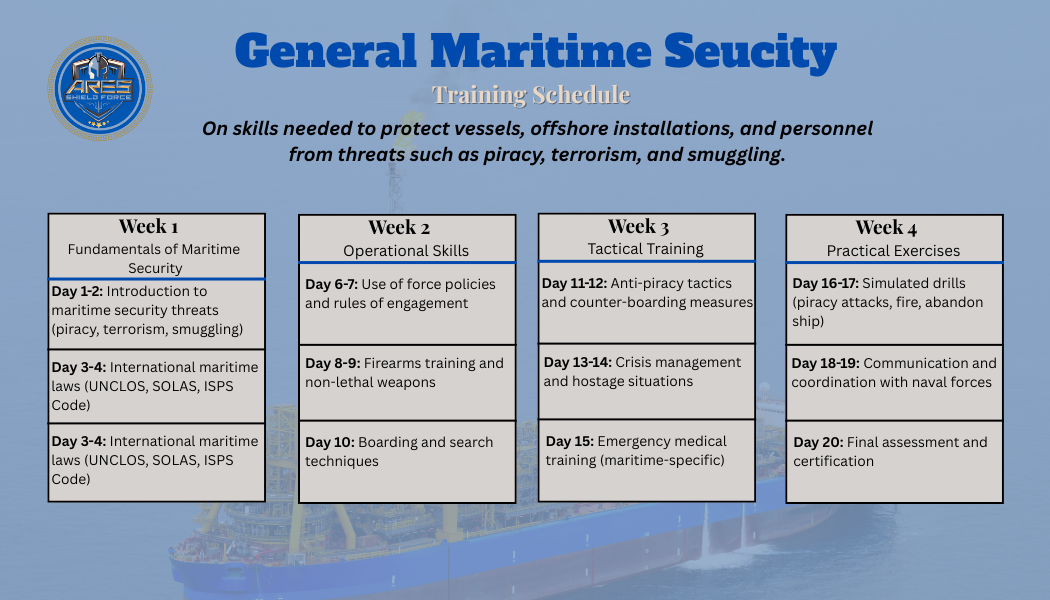
Maritime safety focuses on safeguarding vessels, harbors, and offshre locations from risks as piracy , smuggling and terrorism. Her’s asuggested structure for the training:
Main Training Components

Training in Land-Based Security
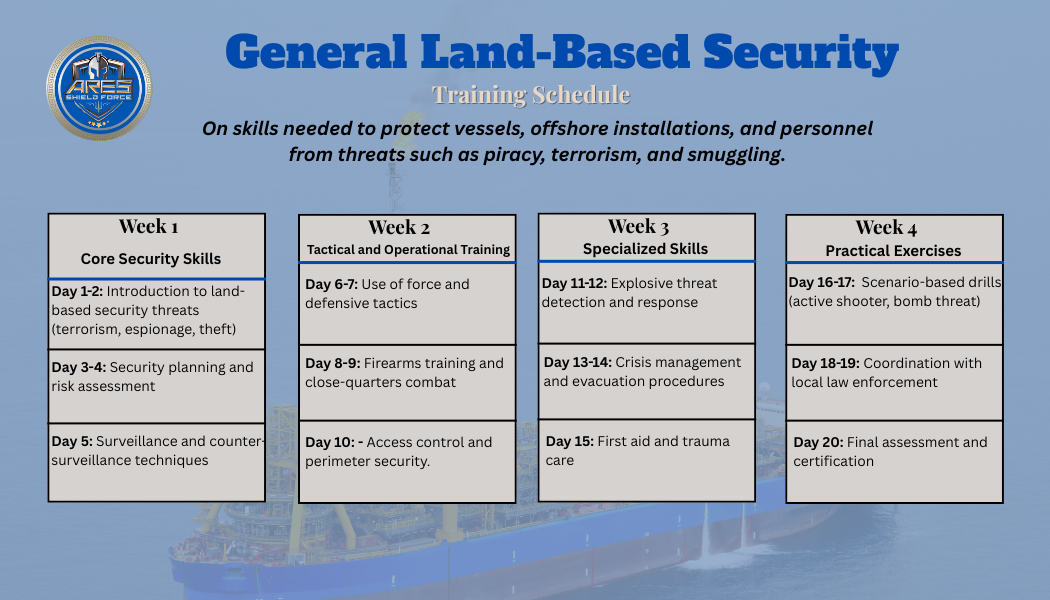
Land-based security in high-risk regions like Afghanistan, Iraq, Dubai, and Qatar requires a focus on urban warfare, counter-terrorism, and cultural sensitivity. Here’s a breakdown:
Core Modules:
- Urban Combat Training: Teach guards how to operate in urban environments, including room clearing and close-quarters combat.
- Counter-Terrorism Tactics: Train guards to identify and neutralize terrorist threats (e.g., IED detection, hostage rescue).
- Convoy Security: Prepare guards for securing convoys in high-risk areas (e.g., ambush prevention, route planning).
- Cultural Awareness: Educate guards on local customs, laws, and languages to avoid conflicts.
- First Aid and Trauma Care: Train guards in advanced medical skills for emergency situations.
Engaging Training Approaches:
- IED Detection and Disposal: Use realistic simulations to train guards in identifying and safely handling improvised explosive devices.
- Hostage Rescue Scenarios: Conduct mock hostage situations to practice negotiation and tactical entry.
- Ambush Drills: Simulate ambush scenarios to train guards in rapid response and defensive maneuvers.
- High-Risk Environment Simulations: Recreate real-world environments (e.g., desert, urban, mountainous) for immersive training.
- Onboard Security: Educate on safeguarding cargo, personnel, and essential areas of the ship.
- Maritime Laws and Standards: Inform on global maritime regulations (such as SOLAS and ISPS Code)
- Search and Rescue (SAR) Skills: Prepare personnel for emergency rescue scenarios at sea.
- Maritime Weapons Training: Safe handling of firearms and non-lethal options in a maritime setting.
- Counter-Piracy Techniques: Instruct personnel on managing pirate situations, including preventing boarding and effective response measures.

Combined Training for Maritime and Land-Based Security
Some guards may need to operate in both environments, so consider cross-training programs:
Core Modules:
- Transition Operations: Train guards to move seamlessly between maritime and land-based roles.
- Integrated Threat Response: Teach guards to handle hybrid threats (e.g., pirates collaborating with land-based insurgents).
- Communication and Coordination: Train guards in using advanced communication systems for joint operations.
Engaging Training Approaches:
- Beach Landing Drills: Simulate amphibious operations where guards transition from ship to shore.
- Port Security Scenarios: Train guards to secure ports while coordinating with land-based teams.
- Multi-Threat Simulations: Combine maritime and land-based threats in a single exercise (e.g., pirate attack followed by a land ambush).

Specialized Training for High-Risk Regions
Tailor training to the specific challenges of regions like Afghanistan, Iraq, Dubai, and Qatar:
Core Modules:
Afghanistan and Iran
- Insurgency and Guerrilla Warfare: Train guards to handle asymmetric threats.
- Desert Survival Skills: Teach navigation, hydration, and survival in harsh desert conditions.
- Cultural Sensitivity: Educate guards on local tribal dynamics and conflict resolution.
Dubai and Qatar
- High-Profile Event Security: Train guards to protect VIPs and large-scale events.
- Cybersecurity for Critical Infrastructure: Teach guards to protect digital systems in ports and facilities.
- Luxury Asset Protection: Train guards to secure high-value assets like yachts and private estates.
Advanced Technology Integration
Incorporate modern technology to enhance training effectiveness:
- Drones and Surveillance: Train guards in using drones for reconnaissance and threat detection.
- Cybersecurity for Maritime and Land Operations: Teach guards to protect digital systems from hacking and cyberattacks.
- Virtual Reality (VR) Simulations: Use VR to create immersive training scenarios for both maritime and land-based operations.
Bring Innovation to Your Security Career
Let’s start the journey towards success and enhance revenue for your business. Take your company to the next level.
Training Schedule
FAQ
1) What services does your security company provide?
We offer comprehensive security training and solutions, including maritime security, land-based security, specialized training for high-risk regions, and advanced technology integration for surveillance and protection.
2) How can I enroll in your security training programs?
You can enroll by visiting our Training Programs section on our website, filling out the registration form, or contacting our support team for assistance.
3) Do you provide certification after completing the training?
Yes, all our security training programs come with industry-recognized certifications that validate your expertise and compliance with global security standards.
4) What qualifications do I need to join the training?
The requirements depend on the type of training. Basic courses require no prior experience, while advanced programs may need relevant experience or qualifications.
5) Do you offer online training courses?
Yes, we provide both online and on-site training options for maximum flexibility. Online modules include virtual simulations and interactive learning sessions.
6) How secure is my data when I use your services?
We implement the highest cybersecurity measures, including data encryption and secure access controls, to protect your personal and professional information.
7) Can your company provide security consulting for businesses?
Absolutely! We offer customized security consulting for businesses, government agencies, and private individuals to ensure a comprehensive security strategy.
8) Do you offer security solutions for high-risk regions?
Yes, we specialize in security strategies for high-risk regions, including Afghanistan, Iraq, Dubai, Qatar, and maritime zones prone to piracy.
9) What technology do you use in your security solutions?
Our security programs incorporate drones, cybersecurity protocols, AI-based surveillance, and VR simulations for advanced training.
10) How can I contact customer support?
You can reach us via email, phone, or our online contact form. Our support team is available 24/7 to assist you.